Showing posts with label Fe-ConE. Show all posts

Friday, January 11, 2008

WBTs on e-Learning for free!

During the European project Fe-ConE, we developed 6 WBTs about e-Learning. This was not the goal of the project but a way to do research. The 6-week course on e-Learning Fundamentals hold a lot of didactical activities and one of them was a kind of old fashioned WBT.

I host 3 of the 6 WBTs (in English) on my own Dutch Blog, please feel free to look at them. These are not the best I could do (due to extreme time constraints) but maybe you will find it useful.

BTW: all the learning materials are published under Creative Commons licenses so let me know if you want to re-use it. I have the files in native eXe format.

> WBT “e-Learning Basics”

> WBT “e-Learning Tools”

> WBT “e-Learning Trends”

Enjoy!

Sunday, October 21, 2007

Intercultural presentations!

At this moment I'm waiting at the airport in Detroit. Tonight we will go to Orlando to be at Learning 2007 from Elliott Masie. I can't wait! My colleague Erika and I are hosting a session with the title 'e-Learning for a worldwide audience', we will use the Hofstede model to explain the design guidelines for e-Learning.


Last week I was in Lituania to present about this issue at well, although this was a small seminar, it was interesting to share thoughts about cultural contexts with people from 20 different countries.


The same week I was working for the Council of Europe, this was a general session on e-Learning but I showed the intercultural course and also here people got really into the subject of cultural dimensions of learning.


I'm wondering how many people will show up at our session in Learning 2007. I am surprised by the many conversations and request for presentations I had on the subject of multicultural approaches in e-Learning. It is certainly hot.

You will find more on Learning 2007 on this blog (daily base) and for the Dutch readers: I will publish a daily post on www.e-learning.nl

Thursday, April 19, 2007

Intercultural Learning!

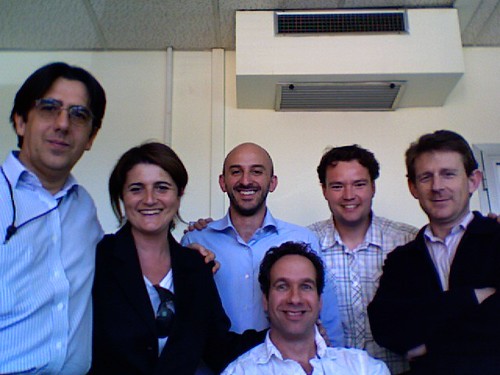
The last days we (Luuk and I) have spend in Rome with the Spanish/Italian/Dutch development team. Our task and mission is to create a feasible and powerful course on e-Learning Fundamentals for a varied group of learners. We are aiming at 250 learners, all over Europe.

The course will be build using the cultural model of Hofstede. With the course we are testing if the variables of Hofstede are also suitable when we are talking about e-Learning and a young, globalized population.


The development team

E.g. to explain it a bit: Hofstede is using Uncertainty avoidance as a differentiator for intercultural audience. People from a culture with a high score on uncertainty avoidance will prefer highly structured and leading learning content with a clear and straightforward language. People from cultures with a low uncertainty avoidance will prefer more explorative, open learning situations and content. An example of a country with low uncertainty avoidance is The Netherlands (score 51/100), a country with high uncertainty avoidance is Greece (score 95/100). We will create the course in such a varied way that the preferences will lead us to the conclusion if the Hofstede model is suitable for e-Learning and new generations as well.

The course will start on 21st of May and will have duration of 6 weeks. Every week will have a Teaser, a WBT, a learner generating content activity and a Reflection activity. We will use Moodle as the learning platform and eXe as the WBT creation tool.

If you are interested in participating in the course, just drop a mail or reaction.

Thursday, February 15, 2007

Intercultural learning


On Sunday I'm flying to Innsbruck (Austria) to have a meeting with an international group of people from the Fe-ConE project. The participants (from Spain, Italy, Greece, Lithuania, Poland, Austria and the Netherlands) are coming together for two days.

Fe-ConE is a 2-year project funded by the European Commission about intercultural e-Learning. Actually, within the project we want to develop a model and decision making tool for the development of e-Learning courses. We are convinced that although e-Learning suppose to fit easily into a world wide audience, there are some significant differences between learners from different cultures. And what kind of didactical form is working for what population?

Within the project we are using the models of Hofstede. He defines culture as:

"The collective programming of the human mind, which distinguishes the members of one society or group from those of another."


Hofstede distinguishes cultures by the following aspects:

  1. Power Distance [this dimension indicates the extent to which less powerful people in a society accept that power is distributed unequally].
  2. Individualism [this dimension indicates the degree to which individuals are required to look after themselves and their direct family only].
  3. Masculinity [this dimension indicates the degree to which achievement and success, in contrast to nurturing and family orientation, are important societal values].
  4. Uncertainty Avoidance [this dimension indicates the extent to which people feel threatened by uncertain situations].
  5. Long-term Pragmatic Perspective [this dimension indicates the extent to which society displays a pragmatic, future orientated perspective rather than a normative historic or short-term point of view].
Later on I will explain more about the implications on learning because all these aspects are influencing the way learners are working together, the way they react on a teacher, the way the are used to reflect on the learning process and so on. E.g. an American teacher will introduce himself with his first name (just call me Ed) while Japanese learners will find this very inappropriate and are used to a more formal way of communicating. This kind of differences can disturb the learning process or can even keep learners from learning.

Within the next months we will deliver a course on e-Learning content development and this course will be available for free (under creative common license) for everybody. Will be continued.

More info about the project see the website, for more info on Hofstede model see wikipedia or the Hofstede website.