Showing posts with label game based learning. Show all posts

Friday, December 21, 2007

GPS game with runners and surfers

Yes, it is pretty exiting to walk around with a GPS receiver, towards waypoints to collect some new clues. This week we went with a big group of Stoas to a very nice town called Deventer.

The game was a nice mix of activities. In total we had 4 timeslots of 30 minutes. In the 30 minutes we divided our team in two sub team: 'Runners' walked through the city with a GPS receiver to search for predefined 'waypoints' At certain coordinates there was an object we needed. Via the mobile phone we stayed in contact with our team mates who played the role 'surfers'. The surfers sat behind a laptop and had different assignments. The surfers needed to solve online puzzles and had to answer certain questions. They could use internet to solve things. If they answered a question not correctly, the pages were blocked for a minute. The surfers had to provide the runners with questions that were related to the certain spots in the city. This way the tasks were involving and not boring at all. The runners needed to be back at the base (a warm and nice café of course) on time.


I could imagine that you can turn this quite easily into an educational game e.g. for new hires to explore the company (at least from the outside). You only would like to do a bit more at certain locations so I would prefer to use a GPS enables PDA or iPhone. With that you can do different assignments and use the web for additional info and to enter the answers. But the way we did it (with a collaborative task and a simple receiver) was also challenging and fun. It is motivating to team up with people at a different location and to put together the pieces of the puzzle.

The Surfers are working very hard!

If you want to set up games like this you can use free available software tools, one example: http://www.mscapers.com/

Sunday, December 02, 2007

'De Blob', from a school project to the Wii.

'De Blob' is a very successful game made by students of the Utrecht School of the Arts (HKU) and Utrecht University. It was created some time ago but I heard about it on the NLGD day two weeks ago.

De Blob

The Blob-game wants to inform the citizens of Utrecht about the upcoming project to redesign and rebuild the area of the main railway station. Great thing about the Blob game is the way you move the Blob, a big ball, through the city. The graphics look detailed and nice. One of the students posted something about their study project and THQ picked it up. The game will be on the Nintendo Wii and the DS in 2008 (of course with some extra features and extended gameplay). The title will be the Dutch one: "De Blob".

Joost van Dongen, the lead programmer, describes the game as:

It is a 3D game in which the player controls a ball of paint rolling through the city. The ball can absorb coloured NPC’s to become larger and change its colour. With the paint, the player can then proceed to paint the entire city. Almost everything is paintable: buildings, trees, cars and using the paint trace even the ground. The main goal of the game is to paint all 17 landmark buildings. Hardcore fanatics can also try to collect all 50 coins that are hidden around the level.


You can download and play the game from the students for free. It is available in Dutch and English and it is a Windows game. It is very playable with a trackball or touchpad. With the mouse is a bit annoying.

I would not consider it as an edugames because the learning objectives are very thin. And even the informative elements are quite limited. But it is fun to play, you can enjoy the graphics and the easy way you can roll De Blob around town. If you are developing games as a student: you see what it can bring you so create a great edugame and share it with us and the THQs of this world.

Some info about the THQ release:


Go download the English version or the Dutch version.

Thursday, September 27, 2007

Immersive learning simulations webinar

This week I joined a webinar about IMMERSIVE LEARNING SIMULATIONS by great experts like Clark Quinn (author of Engaging Learning). It was a one hour event based on research findings in a report, that you can buy from the site. Although the way it was done was quite straightforward (slow PowerPoints, audio and a side-chat) the content was interesting. Adobe Acrobat Connect was used. You can see a recorded session at the website.

See for yourself that the content is great but the interaction was poor. I was missing basic things like pictures of the speakers and graphics with an additional value. The start was static with a picture of the frontpage of the report for almost 5 minutes. I would expect more from a fine group of experts like Quinn and Schlenker. Teach what you preach!


The model behind this site is triggering. If you sign up for free as an Associate, you can gain points by filling out your profile and filling out surveys. The outcome of the surveys will be analysed in their reports. For your points (called 'Guilders') you can get all kind of goodies as PDF-version of the reports, coffee mugs, USB-sticks and many more. As an Associate you can download abstracts. Actually there is nothing interesting to see in these abstracts besides a lot of index pages and some graphs. So you have to fill out surveys or pay to get the good stuff.

Go visit the eLearning Guild website for more info.

Thursday, September 20, 2007

Virtual fire extinguisher training system!

Some skills are hard to train within a real situation. Or dangerous, or expensive. We all know the flight simulators and the car driving simulators.

But now it is also possible to train your fire extinguishing skills with a virtual fire. The BullsEye system uses laser technology to simulate the discharge of a dry chemical extinguisher. You will even hear the sound of discharging an extinguisher.


No hassle, no money per training experience and no pollution. Only the stress you feel with a 'real' simulation will be missed. And I think that the experience with and the control over your stress is an important aspect of the level of success within the real situation.

For more info please visit to the website of the company.

Thursday, August 09, 2007

Game based learning with a bite!

The game
On the Discovery site you can play a special edugame. For free. Just bring your courage with you.

"Sharkrunners is a game of oceanic exploration and high stakes shark research. Players take on the role of sharkrunners: daring and adventurous marine biologists who seek to learn as much as possible about sharks through advanced observation techniques."


Does this sounds tempting to you? It becomes more interesting if you take a look at the nice merging of real and virtual life within this game. Although your boat and crew is totally virtual, your sharks are not!

"Real-world telemetry data provides the position and movement of actual great white sharks in Sharkrunners, so that every shark players encounter corresponds to a real shark out in the actual ocean."


Game play
Within the game you will face a lot of choices, it begins with the choice of the group you want to be in. Do you like to join a group of extreme activists or a more conservative group of biologists? As a player you can define you own route. With every encounter with the (real) shark you can choose to go on a Zodiak and stay on the surface. In that case the risks are low but also the data gathering will be limited. Or you can go for a dive. If the dive is OK you can improve the skills of your crew. After that you define the direction and speed of the boat.

Interaction design
The game can be played by people with limited IT-skills. The navigation is straightforward and clean. The messages are clear and a decent help is presented. The game is using engaging text, graphics, audio and video in a functional way.

Communication
If you are close to a shark and an encounter is possible, you will receive an e-mail and/or text message on your phone (depends on your preferences). After being notified you have 3 hours to login and to take action. Within the game you also receive messages and your progress is tracked and presented by a 'shipslog'.

Conclusion
This is really a game with a bite. Educational and exiting. Because the fact that you are playing with real sharks makes it a different sensation. It is not as exiting as the time that I was diving with sharks but it comes close!

Play and learn, if you dare. Visit the website, sign on for free and enjoy!


Friday, July 27, 2007

SPORE: "toys can change the world!"

Will Wright previews his new and exiting game, 'Spore'. Maybe the name doesn't ring a bell but sure 'SimCity' and 'the Sims' does. The creator of these sims is working on his new baby. Last year within Saganet we were already talking about this new concept.

Few interesting things:

  1. this is a new example of participatory learning, you create your own universe;
  2. Wright starts talking about his Montessori education;
  3. he sees this as a learning toy;
  4. the game holds some nice and easy object authoring tools;
  5. Wright sees his new game as a way to educate young people about long-term effects of your actions;
  6. nice saying: "Toys can change the world".


See this great TED-video:

Monday, July 16, 2007

Looking back at the ISAGA conference

Gaming is fun and involving and so was the ISAGA conference. The motto of this 5 day conference on gaming and simulation was 'learning by doing'. ISAGA 2007 was held from 9-13 July 2007 in Nijmegen - The Netherlands.

FIVE days?
I think it was great that it was a full week. This gives you the change to focus on the subject instead of your daily activities. And it gives you the opportunity to get a lot of insights and reflection moments.

Atmosphere?
With 200 participants it was a rather small conference (a slightly different than some of the Masie conferences I visited with 3500 participants). It was an informal gathering of game researchers, developers and players. Some were experienced in F2F simulations and games (what was called First Life during the conference), others only knew the digital counterparts (Second Life). It was an inspiring atmosphere with lots of experts. The limited number of people made it possible to have interactive sessions with room for discussion and participation.

Inspiring things?

Well, the level of the presenters was quite OK. Most of them were bringing a lot of enthusiasm and experience to the table. Especially the people who were not from my field (digital learning) offered me some new insights. Most things I saw where not new to me but they gave me some food for thought and I changed some of my views.

Top 5?

  1. Inspiring person: Albert Angehrn, this charismatic guy from CALT in France (http://www.calt.insead.edu/) told us in a very touching way about his experiences in simulation and gaming. Both offline and online they share a few things: they where putting participants in an involving experiences full of emotion and possibilities to get a taste of failure. Albert told us that he thinks failure is important for people to learn. His story about a simulation where a team of managers did a pitstop with a Ferrari formula 1 car made me want to join his team. It was not only a nice marketing concept but it had a very strong scientific base. A true visionair!
  2. Session with customer – a session with a real customer (www.nbc.nl) about a gaming question. Interesting to brainstorm with some other specialist on a specific topic. What was also interesting was the focus on design instead of analysis. The facilitator was pushing a bit to skip that phase. Nice outcome was that gaming was only a part of the solution and the advice was to put more effort in building an interactive community (within a virtual learning environment).
  3. Session on virtual worlds. Igor Mayer told about the experiences of the technical university of Delft with virtual worlds. He showed some examples of students who created content in Second Life and Active Worlds. In SL students imported a floating building (from a 3D graphic application) to start discussions about their design and in AW students played with a simulation of the restructuring of the railway area in Delft.
  4. Gert Jan Hofstede showed us why we play. In his session it becomes clear that playing is essential for living and it is in our genes for quite a long time. Interesting to put the motor behind game based learning in a historical, cultural and biological perspective. Play is not just for fun only; it has a function! It makes you as human happier and with playing you improve your skills.
  5. YY Cai from the Singapore Science Center showed us the cutting edge examples of virtual reality. He talked about the various input devices and he even used music in a totally new way (to explain biology subjects he synced music with structure of enzymes).

Some more?
Well besides the five sessions I went to a great explanation of Paul Maharg of the Law simulation 'Ardcalloch' (a 12 week intensive online simulation, an OSS tool to create this will be published: 'SIMPLE'), a session about a game design software tool ('CAGE' from an university of Finland) and I had a lot of nice discussions during diners and in between sessions.

Next year in Lithuanian!

Monday, July 09, 2007

ISAGA conference

Today the 5-day ISAGA conference started. This yearly event about gaming and simulation takes place in Nijmegen, The Netherlands.


I'm there with a colleague of mine, Yvonne, who is a graphic designer. The conference is using the concept of 'Learning by doing'. You can choose between different kind of activities. One of the things you can do is to create a game for War Child. Parallel to this you have thematic sessions (3 hours) or single paper sessions. After these there are open sessions: anybody can initiate that.

We went to a thematic session about designing educational games and simulations. For me this was too much a learner oriented approach. We did all the work even without much feedback or reflection from the facilitators. It left me with an idea that I could do that without them. The good thing was that we defined the criteria for a good game from many different perspectives (designer, client, player, victim, etc.). After that I went to a session in where a real client with a real problem asked for some input about how to use gaming to solve his problem. This was a very interesting session. We ended up with a solution with only a small emphasis on gaming but with a strong community with all kind of collaborative learning activities (based on a VLE instead of a virtual world or game).

I'm feeling lucky to focus a whole week on GBL and to share ideas with gaming professionals from 20 different countries!

Monday, July 02, 2007

PeaceMaker: great educational game

Gaming is bad?
After all the discussions in the media about Manhunt 2 (see an article in USA Today) it is good to talk about all the strong and significant positive effects of games. It is a pity that media are not focussing on the game PeaceMaker. The first time a game really forced me to think about my own values and attitude was when I played September, 12th. This great game was developed after the terrorist attack in New York City and I used it a lot during presentations on game based learning because for me it shows the strong potential of educational games.


The same feeling was there when I played PeaceMaker. On their site you can read:

PeaceMaker challenges you to succeed as a leader where others have failed. Experience the joy of bringing peace to the Middle East or the agony of plunging the region into disaster. PeaceMaker will test your skills, assumptions and prior knowledge. Play it and you will never read the news the same way again.


Which president do you want to be?
It is true. For only 19,95$ you can be either a Palestinian or Israeli president trying to cope with the complex situation. You decisions are based on your knowledge and attitude. You can make different choices (although it is not really possible to behave in the worst and violent way when you are playing the Palestinian president). This game is very well developed. It is a straightforward game with basic but nice graphics. You don't realize it is quite simple while you are playing the game You are not running around in a 3D world but you don't miss it any moment. The designers used movement in a very subtle way. The game play is very well balanced (attractive and challenging). The interface is well designed, clean and simple. You just start playing without worrying about how to do it. You find out how to do it while playing. The real multi media footage is giving the game its urgency and realistic atmosphere. It pulls you into the game and it will get you some shivers as well.

Learning different things
While playing this game, you learn about the different issues like security, national and international partners, the national and international politics, about natural resources and many more. It puts you in the middle of the action. The feedback is well presented and is adding a lot of flavour to the game. The developers surely know how to use gaming principles.

PeaceMaker make you think about the complexity of the situation and it is great that you can play both sides. That forces you to look at it from different points of view. It will not only learn some new facts to you but probably will change your ideas and gives you a deep understanding of the conflict in his historical context. It will shake up you emotions as well. But, hey…that is a small price for learning this kind of lessons.

Get the demo or just buy the game at their website.

Watch the game play trailer:

Thursday, March 01, 2007

Game based learning seminar

Stoas is organizing free seminars for quite a long time. During several years we had interesting sessions, mostly about developing e-Learning content. In about 3 hours we presented cases from customers (and by customers) and explained all kind of didactical models and methods and we discussed it with the participants. It is always a great opportunity to meet other professionals and discuss all aspects. Only in interaction you are changing and 'upgrading' your own mental model. Every time it is with a small group of people (20-25) and we are closing the sessions with an informal lunch. For the participants it is interesting to get some information and to meet other people to hear their experiences with e-Learning (especially during the breaks and lunch). They are always rating the event positively. And for us it is a great opportunity to hear what the wishes, dreams and concerns are from our (potential) customers.

Now we are starting with a seminar about game based learning. Many times the term GBL or serious gaming is misleading and is just an excuse to cover up a bad designed e-Learning product. That’s why we started this seminar, to evaluate this phenomenon and to talk with people about the positive and negative aspects. I will also talk about the ingredients of a good and usable educational game and how to implement it in your environment. From a critical, educational point of view. Other colleagues of mine are presenting research results about GBL.

If you are interested to join us on for this free event on Friday the 13th. Do you dare?


To subscribe please go to the website


Video impression of our GBL seminar.

Friday, February 09, 2007

Learning in Second Life?

Today I thought my mind was following his own plan. Well, I visited the "Virtual Hallucinations Center" of UC Davis and University of Queensland in Second Life.

This is one of the many spots, which are build with an education reason. The center is created to let you experience the daily life of a schizophrenic patient. In this center you can walk through a building and find yourself in certain unpleasant and depressing situations. You start your 'trip' with choosing a male or female voice. During the experience some scary voices will pop up into your head. You will get some orders to kill yourself or pick up a gun. You will also experience what it will mean if you encounter visual distortions.

For me this is just a simple educational experience but it shows a little bit about the potential. It can give you an experience, which is otherwise difficult to obtain. For some visitors the experience can have an emotional impact but for me the experience was not that intense. The reason is that the quality of the graphics is from a 1985 level. And the user interface is keeping me from a total and overwhelming involvement. Too much attention is needed for navigation and interaction with the environment. For me it would be more valuable to have the same info from their website, with a nice video or a great animation.

It reminds me of the first days of streaming audio on the web: you were feeling that something special was happening but the quality (due to bandwidth limitations) was too bad to get the message straight. Now we can enjoy streaming audio to the full extent and we can focus on the content.


Your image in the mirror is dying and a voice is
telling you to kill yourself


The floor at first sight....


..and after a moment the floor changed into
water with stepping stones.

If you want to visit the center, just search for "UC Davis".

Saturday, December 23, 2006

Your own educational Second Life?


Active worlds is an online environment where you can walk around like in Second Life. The company is positioning themselves as an educational solution as well.

They say:

"The 3D classroom -
Students no longer have to be physically sitting in front of you to learn. Instead, you can create a 3D classroom in which students are present in the form of an avatar (virtual body). Once everyone’s online, you can teach them using chat (typed or VOIP), audio and visual aids including pictures and streaming video. Just like in a real classroom, your students can see and hear what everyone else is saying. But unlike a real classroom, our 3D Web Worlds can be instantly entered by students living all over the world. Once your students have downloaded the browser, they can open it in just one click from the icon on their desktop. Virtual classrooms are the learning tool of the future. What could you achieve in yours?"


You can have a private or public world. Just tried a demo. You can use an integrated webbrowser and links from within the world can be viewed in one half of the spilt screen. Works OK. The performance was not that good. Walking around means that I had to download the whole time and my graphic card of my laptop hold me from enlarging the window.

The costs are OK if you start, a piece of land is 80 euro a year, if you want to upload your own items (like video) it cost an extra 120 euro per year. For 5 extra users you pay 50 euro a year. Don't know if these are named users otherwise it is quite an expensive class if you have to pay for every learner.

I'm having serious doubts if this kind of virtual worlds are as useful as the classical 2-d virtual classrooms like LearnLinc or open source ones. And why would you like to use this Active Worlds environment instead Second Life?

More info at their website.

Tuesday, December 19, 2006

Wii-learning?

After the battle of the game consoles has started I was wondering if the Wii from Nintendo has some promising potential for learning. With the controller you have to use your whole body/arms.

When we look at different ways we are remembering things, one of the memory types is the physical (bodily-kinesthetic) learning style (see also wikipedia about Kinesthetic learning). You use your body and sense of touch to learn about the world around you.

Would it be possible to use the Wii for more than just gaming? Maybe it would be possible to design some gamebased learning with the Wii? Can it be used e.g. for a course where you have to learn how to use certain physical machine. Or to extinguish a fire. Or....

Why not....put some extra flavour. Also a simulation used by pilots to learn how to fly is using this bodily-kinesthetic learning style to create contextualized, powerful learning.

Update: today Opera and Nintendo announced a webbrowser for the Wii. Download the browser from the site.

Kid using the Wii in a boxing game...what a joy!

Saturday, December 09, 2006

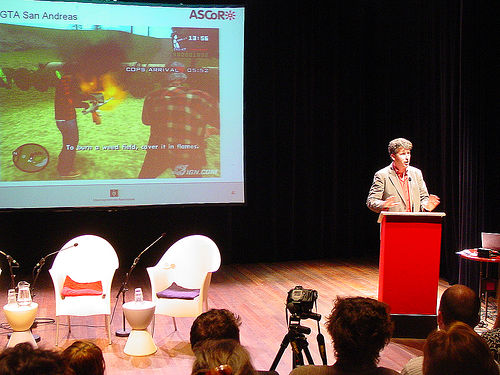
Game event with presentations

Yesterday and today (and don't forget the nights!) there were different kind of activities around Gaming.

I skipped the LAN-party but joined some presentations to see if they were coming up with some valuable insights about gaming which can be used within game based learning situations.

Yesterday I saw a presentation about the history and future of gaming by Wouter Baars. Interesting but not that new to me. He is a technical guy and didn't have a lot of presentation skills.


Today I went to listen to Jeroen Jansz. A very interesting researcher from the University of Amsterdam. He is doing research about gaming for 3 years now and with a involving way of presenting he gave us some clear insights. He is proving what Steven Johnson is telling everybody: that gaming is not such a bad activity and can be very benificial. Keep an eye on his research...it is impressive!

For the Dutch readers: he also wrote the chapter about videogames in the excellent book from the SCP: Jaarboek ICT en samenleving, de digitale generatie (zie ook www.uitgeverijboom.nl).